
Key Takeaways
- Brand partnerships vs affiliate marketing isn’t about choosing the cheaper option, it’s about selecting the right creator partnership model for your campaign goals.
- Brand partnerships are ideal for building awareness, trust and long-term brand value that continues to influence future purchase decisions.
- Affiliate marketing for brands works best when audiences already have purchase intent, especially when paired with strong offers or promotions.
- Performance based influencer marketing should be measured beyond attributed sales, as creators often influence customers long before they convert.
- A hybrid creator partnership model combines long-term brand building with measurable performance, making it suitable for campaigns with multiple objectives.
Many brands ask the same question before launching a creator campaign:
Should we pay creators a fixed fee or work with them on affiliate commission?
The answer isn’t about which payment model is better. It’s about what you want the creator to achieve.
If your goal is to introduce a new product, change brand perception or create content your brand can reuse, a traditional brand partnership often delivers the greatest value.
If your goal is generating trackable sales from an audience that’s already ready to buy, affiliate marketing may be the better fit.
In reality, many successful campaigns combine both.
Here’s how to decide which model makes the most sense for your campaign.
What’s the Difference Between Brand Partnerships and Affiliate Marketing?
To audiences, both types of collaborations often look identical. A creator might recommend a product, demonstrate how it works or share a purchase link.
What Brands commonly Overlook When Choosing a Creator Model
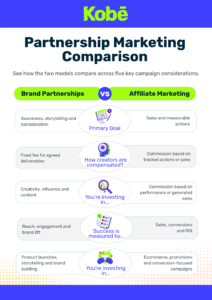
Choosing between a fixed-fee partnership and affiliate marketing isn’t simply a budgeting decision. Yet it’s common for brands to focus on cost before considering what they actually need creators to achieve.
Here are some of the most common considerations we see overlooked:
-
Prioritising cost over campaign objectives
A lower upfront cost doesn’t always lead to better results. The payment model should support your campaign objective, whether that’s building awareness, driving sales or creating long-term brand value.
-
Expecting every campaign to drive immediate sales
Not every creator campaign is designed to generate conversions. Some are intended to build awareness, educate audiences or influence purchase decisions over time.
-
Measuring success using only attributed conversions
Sales are important, but they don’t tell the whole story. Metrics like engagement, brand lift and content quality can be just as valuable depending on your campaign goals.
-
Overlooking the full customer journey
Consumers rarely convert after a single interaction. A creator may influence the buying decision even if the final purchase happens through another channel days or weeks later.
-
Assuming one payment model fits every campaign
Brand partnerships and affiliate marketing serve different purposes. In many cases, a hybrid approach offers the right balance between brand-building and measurable performance.
A key takeaway is instead of asking “Which payment model is cheaper?” ask “Which model is best suited to achieve our campaign goals?”
Once you’ve defined your campaign objective, choosing between a brand partnership and affiliate marketing becomes much simpler. Rather than asking which model is “better,” the better question is which model is designed to achieve your goal.
When Should You Choose a Brand Partnership?
A brand partnership is about more than paying a creator to publish content, it’s an investment in their ability to shape how audiences perceive, trust and engage with your brand.
Unlike affiliate marketing, where success is measured primarily through trackable actions, brand partnerships are designed to influence the earlier stages of the customer journey. They help build awareness, educate potential customers and create meaningful connections before someone is ready to make a purchase.
This makes brand partnerships particularly effective when your campaign aims to:
- Launch a new product or enter a new market
- Increase brand awareness and visibility
- Educate audiences about a product or service
- Create high-quality content that can be repurposed across marketing channels
- Build long-term relationships with creators and their communities
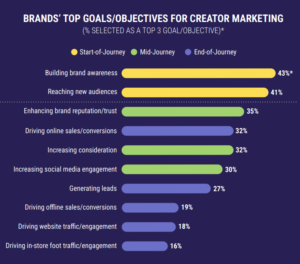
According to the IAB Creator Economy Ad Spend & Strategy Report, building brand awareness (43%), reaching new audiences (41%) and enhancing brand reputation and trust (35%) are among the top reasons brands invest in creator campaigns, demonstrating that creators play an important role well before the point of purchase.
It’s also important to remember that the value of a brand partnership isn’t always reflected in immediate sales.
A customer might first discover your product through a creator’s Instagram Reel, save the post, research it a few days later and eventually purchase it through Google, a marketplace or a retail store. While the creator influenced that decision, the sale may never be attributed directly back to them.
Brand partnerships are best suited for campaigns that focus on building awareness, trust and influence before driving conversions.
When Does Affiliate Marketing Work Best?
Affiliate marketing is most effective when the audience is already closer to making a purchase.
Rather than creating demand from scratch, affiliate creators help convert existing interest into measurable action. This makes affiliate partnerships particularly effective for products that audiences already understand and trust. Affiliate marketing performs best when there’s already strong purchase intent, which can be further strengthened by compelling offers, promotions or exclusive discounts.
Affiliate marketing tends to perform best when:
- The product is already well established
- The creator regularly recommends similar products
- The buying journey is straightforward
- Tracking links can accurately measure conversions
- The commission provides meaningful incentive
As Sprout Social explains, performance-based compensation allows brands to directly connect creator payments to business outcomes. However, it also requires clear tracking, attribution and commission structures to ensure creators are rewarded fairly for the value they generate.
Rather than treating creators as another advertising channel, successful affiliate programmes focus on building ongoing relationships where creators continue recommending products naturally over time, increasing authenticity and trust with their audiences.
Affiliate marketing is most effective when demand already exists and customers have a compelling reason to convert.
Why Low Sales Don’t Always Mean the Creator Failed
One of the biggest misconceptions in creator marketing is assuming that low affiliate sales automatically mean the creator underperformed.
In reality, creators only influence part of the customer journey. A purchase decision is often shaped by multiple touchpoints before someone finally converts.
Many other factors can affect whether a customer completes a purchase, including:
- Product pricing
- Promotional offers
- Website experience
- Stock availability
- Checkout friction
- Attribution windows
As a result, a creator may successfully generate awareness and consideration, yet receive no credit if the customer completes their purchase through another channel days or weeks later.
This is a challenge many brands continue to face. According to the IAB Creator Economy Ad Spend & Strategy Report, 39% of marketers say proving ROI is one of their biggest creator marketing challenges, while 34% struggle specifically with attributing sales to creators.
Before judging campaign performance, ask:
- Did the creator reach the right audience?
- Was the offer compelling?
- Was the buying experience smooth?
- Does your attribution model reflect the full customer journey?
Low conversions don’t always indicate low creator impact. Measuring creator success requires looking beyond attributed sales to understand their influence across the customer journey.
Why More Brands Are Combining Both
Rather than choosing one model over the other, many brands are combining fixed payments with performance incentives through a hybrid compensation model.
The fixed fee recognises the creator’s time, creative effort and content production, while the performance-based commission rewards measurable business outcomes. This creates a fairer balance by recognising both the work involved in producing quality content and the results it delivers.
A hybrid approach can be particularly effective when your campaign needs both:
- Strong storytelling and authentic content
- Trackable sales or conversions
Research by impact.com and Adweek found that the majority of creators prefer a hybrid compensation model that combines a flat fee with performance bonuses. This approach recognises the value of their creative work while giving them additional incentives to drive results, making it a win-win for both brands and creators.
To make a hybrid model successful, brands should clearly define:
- Commission structures
- Attribution windows
- Campaign expectations
- Success metrics
before the campaign begins.
A hybrid model works best when your campaign requires both compelling storytelling and measurable business results.
A Simple Way to Decide
Instead of asking:
“How should we pay creators?”
Ask:
“What job do we need creators to do?”
|
Campaign Goal |
Recommended Model |
| Launch a new product | Brand Partnership |
| Increase brand awareness | Brand Partnership |
| Educate consumers | Brand Partnership |
| Drive online purchases | Hybrid Model |
| Generate both awareness and sales | Hybrid Model |
| Build long-term creator relationships | Brand Partnership |
The payment model should support the campaign objective, not the other way around.
Still deciding what type of creator content your campaign needs? While choosing the right payment model is important to consider, deciding between UGC and influencer marketing. Read our guide to learn how each approach supports different campaign goals.
Transparency Still Matters Regardless of the Model
Whether creators receive a fixed fee, free products, affiliate commission or a combination of all three, the relationship should always be disclosed clearly.
Following advertising guidelines helps build trust with audiences while protecting both brands and creators.
Transparency isn’t just a compliance requirement.
It’s part of building credible creator partnerships.
Conclusion
For brands looking to build sustainable growth, brand partnerships should be the foundation of any creator marketing strategy. By building awareness, trust and lasting customer relationships, they create long-term brand value that extends well beyond a single campaign or purchase.
Affiliate marketing still plays an important role, particularly when the objective is to drive measurable conversions, promote limited-time offers or capture existing demand. Rather than replacing brand partnerships, it works best as a complementary strategy that helps turn interest into action.
Ultimately, the strongest creator strategies don’t just focus on immediate sales, they invest in long-term brand equity first, while using affiliate marketing to maximise performance when the opportunity arises.
Planning your next creator campaign? KOBE helps brands build creator strategies that balance long-term brand growth with measurable business outcomes, recommending the right partnership model based on your campaign objectives.
Frequently Asked Questions
1. What’s the difference between brand partnerships and affiliate marketing?
Brand partnerships pay creators a fixed fee to build awareness, trust and content, while affiliate marketing rewards creators with commission for driving measurable actions like sales or sign-ups. The right choice depends on your campaign goals.
2. Why should brands prioritise brand partnerships?
Brand partnerships help build long-term brand awareness, trust and customer loyalty. Unlike campaigns focused only on immediate sales, they continue creating value by influencing future purchase decisions and strengthening brand equity over time.
3. When is affiliate marketing the better choice?
Affiliate marketing is best for campaigns focused on measurable sales or conversions, particularly when your audience already has purchase intent and the customer journey is easy to track.
4. Can brands combine brand partnerships and affiliate marketing?
Yes. A hybrid creator partnership model combines a fixed fee with performance-based commission, helping brands balance brand storytelling with measurable business results.
5. How can KOBE help with creator partnerships?
KOBE helps brands develop creator strategies tailored to their campaign goals, from identifying the right creators to recommending the most suitable partnership model, whether that’s a brand partnership, affiliate programme or hybrid approach.