Key Takeaways
1. UGC and influencer marketing serve different goals
While both are forms of creator marketing, UGC focuses on creating authentic content for brands, whereas influencer marketing is designed to increase awareness, reach and credibility.
2. UGC content is ideal for paid advertising
Authentic UGC content blends naturally into social feeds, making it well suited for paid campaigns while giving brands a scalable library of creative assets.
3. Influencer marketing helps brands reach new audiences
Creators with an established following can introduce products to engaged communities, making influencer marketing an effective strategy for brand awareness and social engagement.
4. There’s no single winner in UGC vs influencer marketing
Choosing between UGC vs influencer marketing depends on your campaign objective, target audience and where your customers are in the buying journey.
5. The best creator marketing strategies combine both
Many successful brands use user-generated content and influencer marketing together, leveraging influencers to build awareness and UGC to reinforce trust, support paid ads and drive conversions.
Have you ever wondered why some brands hire influencers while others pay creators who have almost no followers at all?
Both approaches are becoming increasingly popular, but they aren’t the same. While influencer marketing focuses on reaching an existing audience, UGC is all about creating authentic content that brands can reuse across their own channels.
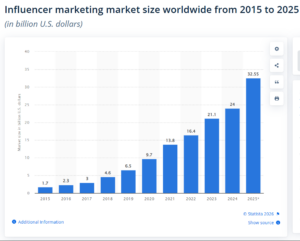
The creator economy is also continuing to grow rapidly. According to Statista, the global influencer marketing market is projected to exceed US$30 billion, showing that brands are investing more in creator-led campaigns than ever before.
Yet one question remains:
Should your brand invest in UGC or influencer marketing?
In this guide, we’ll compare UGC vs influencer marketing, explain where each performs best, and help you decide which strategy is right for your marketing goals in 2026.
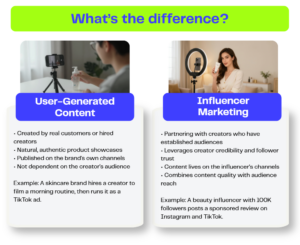
UGC vs Influencer Marketing: What’s the Difference?
Although both involve creators, UGC and influencer marketing serve different purposes.
UGC vs Influencer Marketing: Which Performs Better?
Brand Awareness
🏆 Influencer Marketing
Influencers already have an established community, making them highly effective for introducing products to new audiences. Their followers are more likely to discover and engage with branded content because trust has already been built over time.
While the right approach depends on the product and campaign objective, influencer marketing has proven to drive purchasing behaviour. Sprout Social found that 64% of consumers are more likely to buy from a brand that partners with an influencer they like, demonstrating the role trusted creators play in influencing purchase decisions.
Paid Advertising
🏆 UGC
UGC often feels less like an advertisement and more like content someone would naturally encounter while scrolling. This authenticity makes it particularly effective for paid social campaigns on platforms like Meta and TikTok.
TikTok for Business also recommends designing ads that look and feel like native content, noting that creator-style videos with real people and authentic storytelling tend to perform best on the platform.
Trust
🏆 Both!
One builds trust through authentic customer-style content.
The other builds trust through an existing relationship.
Different mechanisms. Same outcome.
Engagement
🏆 Both!
Both UGC and influencer marketing can generate high engagement, but the outcome depends on the distribution strategy. Influencer content often drives stronger organic engagement because creators have built an active community that regularly interacts with their posts. UGC, on the other hand, performs well when repurposed on brand-owned channels or in paid campaigns, where its authentic, native style encourages audiences to stop, watch and interact.
Conversions
Depends
Many brands now use influencers to generate awareness before repurposing creator-style assets into UGC for paid advertising. This allows a single campaign to support multiple stages of the customer journey.
So Which Should You Actually Choose?
If your goal is to produce lots of authentic content for paid advertising, UGC is usually the better choice.
If you’re launching a new product, entering a new market or trying to build brand awareness, influencer marketing often delivers stronger results.
The right strategy depends on what you’re trying to achieve, not which approach is more popular.
Choose UGC if you want to… |
Choose Influencer Marketing if you want to… |
|---|---|
|
|
Final Verdict
Rather than asking whether UGC or influencer marketing is better, the more useful question is which one supports your campaign objective.
Many of today’s strongest creator campaigns combine both strategies. Influencers help generate awareness and social proof, while UGC provides authentic creative assets that brands can repurpose across paid advertising, websites and social media to drive long-term results.
Conclusion
When it comes to UGC vs influencer marketing, there isn’t a one-size-fits-all answer. Each strategy plays a different role within a successful creator marketing campaign.
UGC content is ideal for producing authentic, scalable assets that perform well in paid advertising and across your brand’s owned channels. Influencer marketing, on the other hand, helps brands reach new audiences, build credibility and create meaningful connections through trusted creators.
Rather than choosing one over the other, many of today’s highest-performing campaigns combine both approaches. Influencers help generate awareness and spark conversations, while UGC reinforces trust and provides versatile content that can continue driving results long after the initial campaign.
Looking to build a creator strategy that combines both UGC and influencer marketing? Connect with KOBE to discover the right creators and develop campaigns that align with your brand goals.
FAQs
What is the difference between UGC and influencer marketing?
The main difference is their purpose. UGC (User-Generated Content) focuses on creating authentic content that brands can reuse across their own marketing channels, while influencer marketing leverages creators with an existing audience to increase brand awareness, reach and credibility.
Is UGC more effective than influencer marketing?
Neither is better in every situation. UGC is well suited for paid advertising and scalable content creation, while influencer marketing is more effective for building awareness, engagement and trust. The right choice depends on your campaign goals.
Can influencers create UGC?
Yes. Many influencers also offer UGC content creation services, producing videos or photos for brands to use in ads, websites or social media without necessarily posting the content on their own channels.
How do I choose between UGC and influencer marketing?
Start with your objective. Choose UGC if you need authentic content for paid campaigns, or influencer marketing if your goal is to reach new audiences and build brand credibility. Many brands achieve the best results by combining both strategies.
How can brands find the right UGC creators or influencers?
Look beyond follower count and focus on audience fit, content quality, engagement and campaign objectives. If you need help finding the right UGC creators or influencers, KOBE can connect you with creators that align with your brand goals and marketing strategy.