
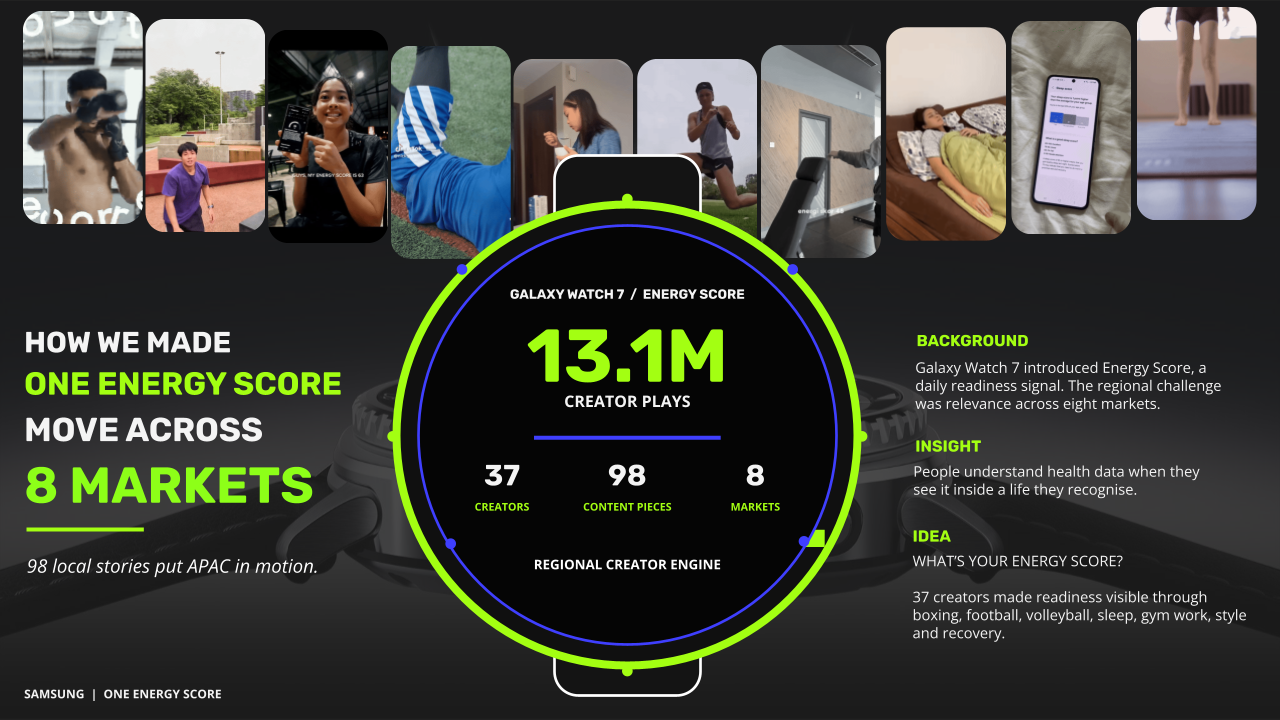
Samsung Galaxy Watch7 had a feature built for everyday relevance: Energy Score, a daily signal that helps users understand their readiness. The regional opportunity was significant. The communication challenge was harder.
A single product story had to work across Singapore, Malaysia, Vietnam, the Philippines, Thailand, Australia, New Zealand and Indonesia. Each market had different creators, routines and cultural cues. A rigid regional script would travel badly. Eight disconnected campaigns would lose the power of scale.
Kobe built one regional creator system around a simple question:
What’s your Energy Score?
Thirty-seven creators answered it through sport, sleep, style, training and recovery. The result was 98 content pieces and 13.1 million reported plays across eight markets.
The work demonstrates Kobe’s regional model: one strategic centre, locally relevant creator expression and coordinated delivery across markets.
TL;DR
– Samsung Wearables activated 37 creators across eight APAC markets.
– One creative question turned Energy Score into 98 locally relevant content pieces.
– Creators demonstrated the feature through recognisable routines including boxing, football, volleyball, running, gym training, sleep and recovery.
– The campaign generated 13.1 million reported plays and 104,000 reported interactions.
– One flexible creative platform protected regional consistency while preserving local relevance.
What challenge did Samsung Wearables face across eight APAC markets?
Samsung needed to make Energy Score relevant across eight distinct markets without fragmenting the Galaxy Watch7 story. The campaign required one recognisable regional idea with enough creative flexibility to feel native in every feed.
The surface problem was awareness. The deeper problem was translation.
Health technology is easy to explain as a feature. It is harder to make personally meaningful. A readiness score gains value when people can picture how it fits into the morning before a workout, the recovery after training or the decision to rest.
The campaign therefore needed to translate one number into many familiar lives.
What strategic insight made Energy Score travel across markets?
The Insight
Health data becomes easier to understand when audiences see it operating inside a life they recognise. Instead of repeating a technical product claim, the campaign let creators demonstrate what an Energy Score meant within their own routines.
Readiness is universal. Its expression is local.
A boxer, runner, footballer and lifestyle creator may all use the same feature differently. That variation was the opportunity. The product did not need eight unrelated messages. It needed one useful signal with eight markets’ worth of human context.
The strategic proposition was clear: make Energy Score feel personally relevant by placing it inside real creator behaviour.
How did “What’s Your Energy Score?” become creator content?
The question worked as both a campaign idea and a content engine. Every creator could answer it through a routine that already made sense to their audience.
One feature became many lived contexts
Creators made readiness visible through boxing, parkour, football, volleyball, running, gym training, sleep, style and recovery. Each context gave Energy Score a recognisable practical role.
Training content showed how readiness could inform effort. Recovery content made rest part of performance. Sleep-led stories connected overnight behaviour with the following day. Lifestyle executions gave the feature relevance beyond elite fitness.
This allowed the product story to stay consistent while the human story changed.
A repeatable structure protected regional consistency
The campaign used a simple creative architecture:
1. Start with a routine the creator’s audience already recognises.
2. Introduce Energy Score at a relevant decision point.
3. Show how the score connects with training, rest or daily readiness.
4. Let the creator interpret the feature in their own voice and context.
Because the structure was repeatable, the campaign could scale to 98 content pieces without reducing every creator to the same script.
This regional orchestration is part of Kobe’s end-to-end influencer marketing solution , covering creator discovery, campaign management and reporting across markets.
What results did the Samsung Wearables campaign achieve?
Campaign Results
Across eight APAC markets, 37 creators produced 98 content pieces that generated 13.1 million reported plays. The participating creators represented a combined followers of 22.9 million, while campaign reporting recorded 104,000 engagements.
The breadth of the campaign is the proof: one product story remained recognisable across 37 creators and 98 distinct pieces of content.
This created a repeatable platform for regional attention rather than a collection of disconnected executions.
The figures above are aggregated from campaign reporting across Singapore, Malaysia, Vietnam, the Philippines, Thailand, Australia, New Zealand and Indonesia. They reflect reported creator and content-performance metrics across the regional campaign.
Why did this regional influencer marketing campaign work?
Kobe designed the regional creator system around three decisions that created leverage.
1) The campaign had one sharp strategic centre
“What’s your Energy Score?” gave every execution the same point of gravity. The idea was easy to recognise and flexible enough to support different creator behaviours.
2) Creator relevance carried the explanation
The feature became understandable through action. Audiences saw it inside the sports, routines and recovery moments they already followed.
3) The system was designed to multiply
The campaign separated what had to remain fixed from what could change. Energy Score stayed fixed. Creator, activity, setting and storytelling style could adapt. Kobe could therefore coordinate one regional story while giving every market room to make it culturally legible.
The same principle powered Kobe’s multi-country CASETiFY creator campaign regional scale becomes more credible when the operating system is consistent and the content remains locally native.
What should regional marketers learn from the campaign?
Marketer Takeaway
Regional influencer marketing scales when the brand defines one behaviour creators can interpret, not one script they must repeat. The strategic centre should remain consistent while casting, context and content format adapt to each market.
The lesson is operational as much as creative.
Build around a behaviour. Product features become memorable when creators use them at a real decision point.
Localise the life, not the proposition. A strong regional idea should survive different sports, routines, languages and creator styles.
Design the campaign for volume before casting begins. If the idea cannot produce many distinct executions, scale will create repetition rather than relevance.
Report with precision. Clear definitions for plays, interactions, creator audience and content output make regional performance easier to understand and trust.
Kobe applies this audience-first approach across creator selection, campaign design and performance reporting. Learn more about its influencer and KOL marketing services in Singapore and Asia.
How can brands build a scalable APAC influencer campaign?
Start with one product truth that creators can demonstrate. Turn it into a repeatable question, behaviour or challenge. Then define the elements that must remain consistent and the elements each market can adapt.
The operating model is simple:
One signal. Local lives. A regional content engine.
Kobe combines regional campaign architecture, relevant creator casting and consolidated performance reporting to help ambitious brands scale across Asia with clarity.
If your next launch needs to travel across markets without becoming generic, speak with Kobe’s influencer marketing specialists.
Frequently Asked Questions
What makes a regional influencer marketing campaign scalable?
A regional influencer marketing campaign becomes scalable when every market works from one clear strategic idea that creators can interpret locally. The Samsung Wearables campaign used Energy Score as the fixed centre while allowing creator, activity, setting and storytelling style to change.
What should remain consistent across markets, and what should be localised?
The product truth, strategic proposition and measurement framework should remain consistent across markets. Creator selection, language, cultural context, platform behaviour and content format should adapt to the audience in each market.
How can a product feature become an influencer content platform?
A product feature becomes a content platform when it creates a repeatable behaviour or question rather than a fixed script. “What’s your Energy Score?” allowed Samsung Galaxy Watch7 creators to demonstrate the same feature through sport, sleep, training, style and recovery.
How should creators be selected for a wearable technology campaign?
Creators should be selected for their ability to make the wearable’s role credible within an existing routine. Audience relevance, content behaviour and contextual fit matter because the creator must demonstrate how the technology supports a real decision, habit or goal.
Which APAC markets were included, and why did market coverage matter?
The campaign covered Singapore, Malaysia, Vietnam, the Philippines, Thailand, Australia, New Zealand and Indonesia. This eight-market footprint required a regional idea strong enough to remain recognisable and flexible enough to feel native across different cultures and creator ecosystems.
How should marketers measure a multi-country creator campaign?
Marketers should define content output, audience scale, plays and interactions consistently across every market, then consolidate the results without confusing attention with business impact. Market-level reporting should also be retained so regional totals do not conceal where performance was concentrated.