
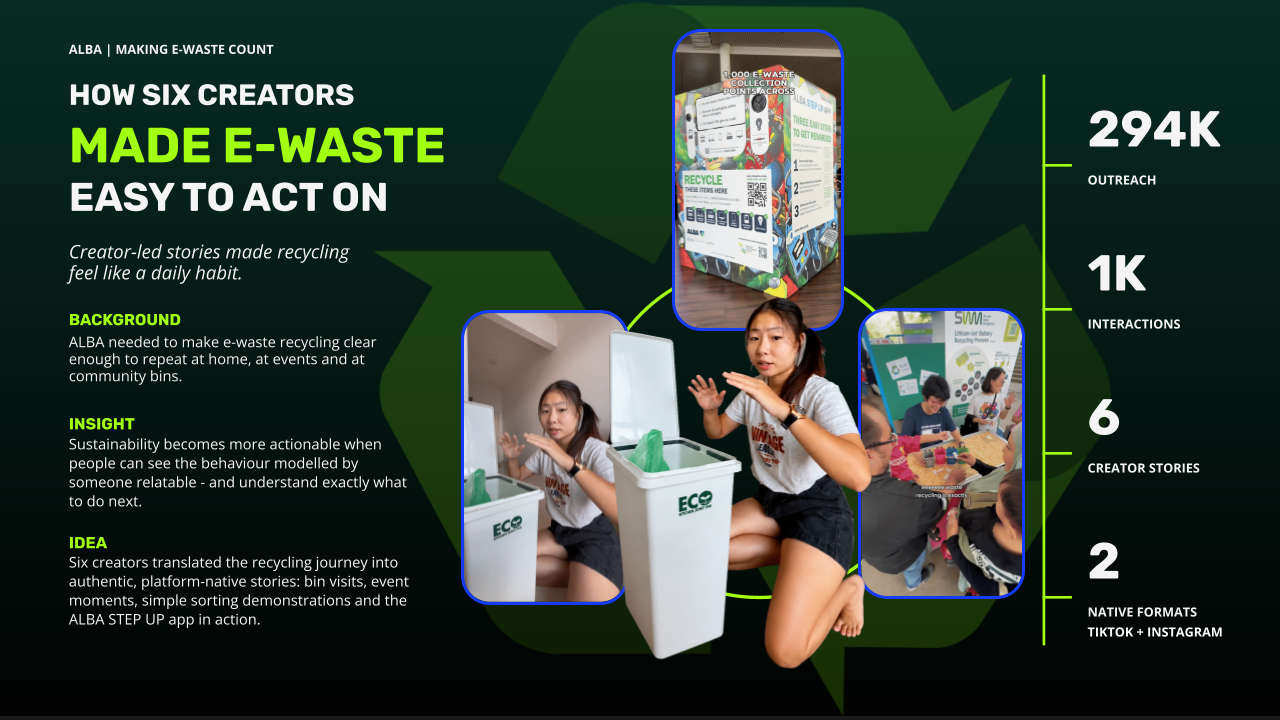
How Creator Stories Made E-Waste Recycling Easier to Picture
What makes sustainability influencer marketing work? People need to see the behaviour, understand the next step and recognise where it fits into their lives.
For ALBA, Kobe built a creator-led public education campaign around a familiar problem. An unwanted device rarely announces itself as e-waste. It looks like an old phone in a drawer, a cable kept “just in case” or an appliance nobody knows how to dispose of.
That truth shaped six creator stories across TikTok and Instagram. The content made the category visible, the process practical and ALBA’s recycling tools easier to discover.
The campaign generated 294K total outreach, and approximately 1K interactions. Its strongest distribution story came from two TikTok creators whose videos travelled beyond twice the size of their respective audiences.
TL;DR
- ALBA and Kobe used six Singapore creators to translate e-waste guidance into recognisable everyday situations.
- The campaign paired TikTok storytelling with Instagram content to show the problem, the disposal journey and ALBA’s support tools.
- Two TikTok videos generated 51K and 55K plays, reaching 2.86 and 2.28 times their creators’ audience sizes.
- The full campaign recorded 294K total outreach, 452K in combined audience size and impressions, and approximately 1K interactions.
- For marketers, the lesson is clear: creator fit includes the ability to interpret a complex message and make its next step visible.
The challenge: make e-waste feel recognisable before asking people to recycle
E-waste is easy to support as a cause. It can be harder to identify in daily life.
Phones, chargers, household appliances and electronic accessories age quietly inside homes. When the moment to discard them arrives, people face practical questions. Does this item count as e-waste? Where should it go? Is a nearby collection point available? Can an app make the process easier?
ALBA already provided collection programmes, drop-off locations and the STEP UP platform. The communication job was to bring those resources into the moment of hesitation.
For the campaign, that meant solving three marketing tasks:
- Make e-waste recognisable through familiar objects and routines.
- Make responsible disposal feel practical through demonstrations and visible tools.
- Make public education relevant inside the feeds people already choose to watch.
The answer could not depend on information alone. It needed interpreters people would stay with.
The insight: people learn a sustainable behaviour by watching it happen
Public education often begins with the correct message. Social content begins with a reason to pay attention.
A creator can bridge that gap. The phone appears in their hand. The collection point appears in their neighbourhood. The app appears inside a real task. A formal instruction becomes a visible sequence.
This changed the role of creator selection. Audience size supported distribution. Narrative fit determined whether each creator could make the behaviour feel natural.
Kobe selected creators who could enter the topic through different parts of everyday life, including family routines, lifestyle habits, visual creativity, community participation and practical demonstrations.
Every creator had one responsibility: make a part of the recycling journey easier to picture.
The idea: one public action, six creator entry points
The campaign used six creators across three TikTok posts and three Instagram posts. Each piece carried the same public education objective through a distinct context.
Make the problem visible
Creators used familiar devices and household electronics to show how widely e-waste appears in daily life. This gave the category a face before introducing the solution.
Make the process practical
Content demonstrated what people could do next, from responsible disposal and collection-point discovery to the use of ALBA’s STEP UP app.
Make participation feel local
Family, community and event-led moments helped place recycling inside recognisable Singapore contexts. The issue moved closer to home because the content did too.
Together, the creator roles built a simple learning journey: recognise the item, understand the route and discover the tool.
Why two smaller TikTok creators carried the strongest distribution story
The clearest marketing lesson came from @jason4ofus and @jercuzzi.
@jason4ofus introduced the practical utility of ALBA’s app, including finding nearby bins. His video generated 51K plays from an 18K audience, producing a 285.66% play rate.
@jercuzzi opened with the scale of the issue: “E-waste is everywhere,” from broken phones to old fridges. His video generated 55K plays from a 24K audience, producing a 228.08% play rate.
Both creators sat in the 10K to 25K audience tier. Their content travelled beyond twice the size of their recorded audiences.
This matters to marketers because creator efficiency can come from interpretation. One creator made the tool useful. The other made the problem impossible to overlook. Both gave viewers an immediate idea to process.
Follower count remains a distribution input. The story creates the reason to keep watching and share.
@jercuzzi E-Waste is EVERYWHERE, from broken phones to old fridges. AND did you know they actually have precious metals inside that can be recycled, but many aren't recycled because of improper disposal? I visited @alba_singapore International E-Waste Day and I was amazed by the amount of effort so many people are putting to make sure e-waste isn't wasted! Make sure you help do your part and download the ALBA STEP UP app to get started! You can earn points to redeem vouchers from Grab, CapitaLand and more! #ALBA #EWaste ♬ original sound - Jeremy
@jason4ofus With the ALBA app, recycling e-waste is easy! Locate nearby bins, book a free pickup, and even earn rewards and vouchers for doing your part. Download the app now! @alba_singapore #RecycleWithALBA #GoGreenSG #Sustainability #ALBA #EWaste ♬ Kids / Happy / Ukulele and Recorder(1517757) - OBiTSU
The results: meaningful distribution around a practical message
Across the supplied campaign report, the content generated:
- 6 creator assets across TikTok and Instagram
- 294K total outreach
- approximately 1K interactions
- 51K plays from @jason4ofus, equal to a 285.66% play rate
- 55K plays from @jercuzzi, equal to a 228.08% play rate
The results show that creator-led e-waste education achieved distribution and active response across two platforms. The two strongest TikTok play rates also show how smaller creators can outperform their audience size when the content delivers clear utility or a sharp reframing.
What brand marketers can learn from ALBA’s creator campaign
Public education content needs more than a credible messenger. It needs a visible behaviour and a focused teaching role.
1. Cast for interpretive skill
Choose creators who can translate the subject through a genuine part of their lives. A strong match gives the message context, vocabulary and a believable reason to appear in the feed.
2. Give every creator a different teaching job
One creator can identify the problem. Another can demonstrate the tool. Another can make the behaviour work for a family or community. Distinct roles create campaign breadth without repeating one script.
3. Build the story around physical proof
Show the device, bin, location, app or event. Visible evidence reduces the mental work required to understand an unfamiliar process.
4. Read performance against creator size
Absolute plays show scale. Play rate reveals how far the content travelled beyond the creator’s recorded audience. The 285.66% and 228.08% play rates provided the campaign’s clearest efficiency signal.
Making public information useful
Influencer marketing earns value when creators make a complex message usable inside everyday life.
For ALBA, the campaign turned e-waste from a broad sustainability issue into a series of recognisable objects, visible actions and practical tools. Six creators gave the same public objective six human entry points.
The strongest content travelled because it helped people process the problem quickly. That is the strategic role creators can play in public education: they make the next step easier to see.
Explore Kobe’s influencer marketing services or browse Kobe’s campaign case studies to see how creator strategy can make complex messages relevant in social feeds.
Frequently asked questions
What is sustainability influencer marketing?
Sustainability influencer marketing uses creators to explain or encourage environmentally responsible choices. The strongest campaigns show a specific behaviour and connect audiences with a credible next step.
Why use creators for an e-waste awareness campaign?
Creators can make unfamiliar recycling processes easier to understand. Their content can demonstrate accepted items, collection locations, event activities and relevant digital tools.
How should sustainability campaign results be measured?
Campaigns should track reach, impressions and engagement alongside behavioural indicators. Useful behavioural measures include app downloads, collection searches, participation and recycling volume.
Can creator content change recycling behaviour?
Creator content can reduce confusion and make the behaviour easier to copy. Evidence of lasting change requires follow-up measurement through collection data, app activity or repeated participation.